

A refrigeration filter drier may look like a small component, but it plays a major role in protecting cold room refrigeration systems, commercial refrigeration equipment, industrial cooling systems, and condensing units. Its main job is to remove moisture, trap solid contaminants, and help keep refrigerant flowing cleanly through the system.
In many refrigeration projects, buyers pay more attention to the compressor, condenser, evaporator, or complete condensing unit. These are important, but small refrigeration components often decide whether the system runs reliably over time. Moisture, acid, metal particles, welding residue, and dirt can damage valves, block refrigerant flow, reduce cooling performance, and shorten compressor life.
This guide explains how a refrigeration filter drier works, why it matters, how to select the right type, and what maintenance signs buyers and technicians should watch for in cold storage and industrial refrigeration systems.
Table of Contents
What Is a Refrigeration Filter Drier?
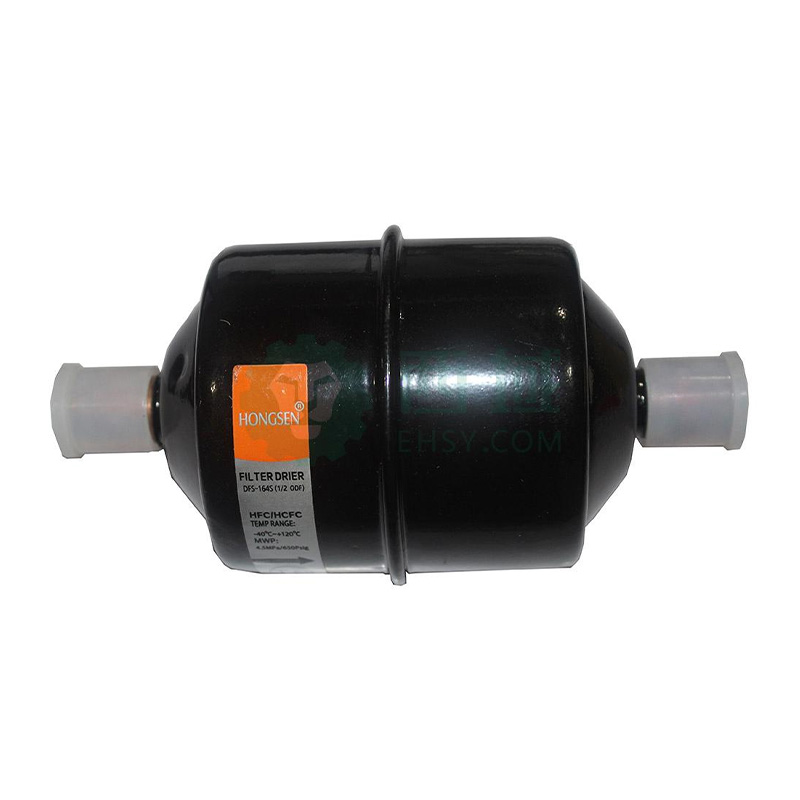
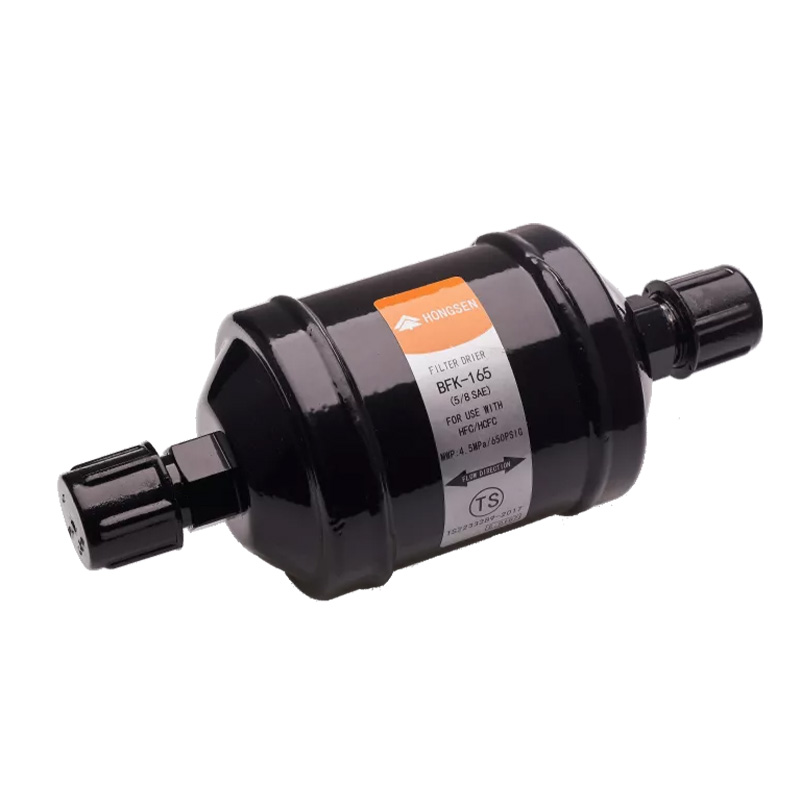
A refrigeration filter drier is a protective component installed in a refrigeration system to remove moisture and filter contaminants from the refrigerant circuit. It is usually installed in the liquid line, but some systems may also use suction line filter driers depending on the application and service condition.
The filter part helps capture solid particles. The drier part contains desiccant materials that absorb moisture. Together, they help keep the refrigeration system clean and dry.
For a basic technical background, a refrigeration system works by transferring heat through a controlled refrigerant cycle. In practical commercial and industrial systems, refrigerant cleanliness is essential because even small contamination can affect compressors, expansion valves, solenoid valves, and heat exchangers.
Rongyi Cold supplies refrigeration components for cold room and industrial refrigeration systems, including filter driers, sight glasses, pressure gauges, solenoid valves, expansion valves, vibration-damping hoses, and check valves.
Why a Refrigeration Filter Drier Matters
A refrigeration filter drier protects the system from two major risks: moisture and contamination.
Moisture can enter a refrigeration system during installation, repair, poor evacuation, component replacement, or leakage. Once inside, it can react with refrigerant and oil, create acid, freeze at the expansion valve, or reduce system reliability.
Solid contamination may come from welding scale, copper oxide, metal wear, dirt, degraded oil, or damaged internal components. These particles can block small passages, damage valves, and affect refrigerant flow.
A suitable refrigeration filter drier helps:
Protect the compressor from contamination.
Reduce moisture-related system failure.
Prevent blockage in expansion valves.
Improve refrigerant circuit cleanliness.
Support stable cooling performance.
Reduce maintenance risks after installation or repair.
Extend long-term system reliability.
For B2B buyers, this means the filter drier should not be treated as an optional accessory. It is part of the system protection strategy.
How a Refrigeration Filter Drier Works
A refrigeration filter drier works by passing refrigerant through filtration and drying media. The outer shell contains internal materials that capture particles and absorb moisture as refrigerant flows through the component.
The filtration section traps solid contaminants before they can move deeper into the system. The desiccant section absorbs moisture from the refrigerant circuit. In a liquid line filter drier, refrigerant passes through the component before reaching the expansion valve. This helps protect the valve from blockage and unstable operation.
In a properly designed system, the filter drier supports the full refrigeration cycle. Rongyi Cold’s compressors, condensing units, evaporators, and condensers should all be protected by suitable system components, especially in commercial and industrial applications where downtime can be costly.
Liquid Line Filter Drier vs Suction Line Filter Drier
Not all filter driers are used in the same position. The two common types are liquid line filter driers and suction line filter driers.
| Type | Installation Position | Main Purpose | Common Use |
|---|---|---|---|
| Liquid line filter drier | Between condenser/receiver and expansion device | Removes moisture and contaminants before refrigerant enters expansion valve | New systems, routine protection, cold rooms, commercial refrigeration |
| Suction line filter drier | Between evaporator and compressor suction side | Protects compressor after burnout, repair, or contamination events | Service recovery, compressor protection, cleanup after system failure |
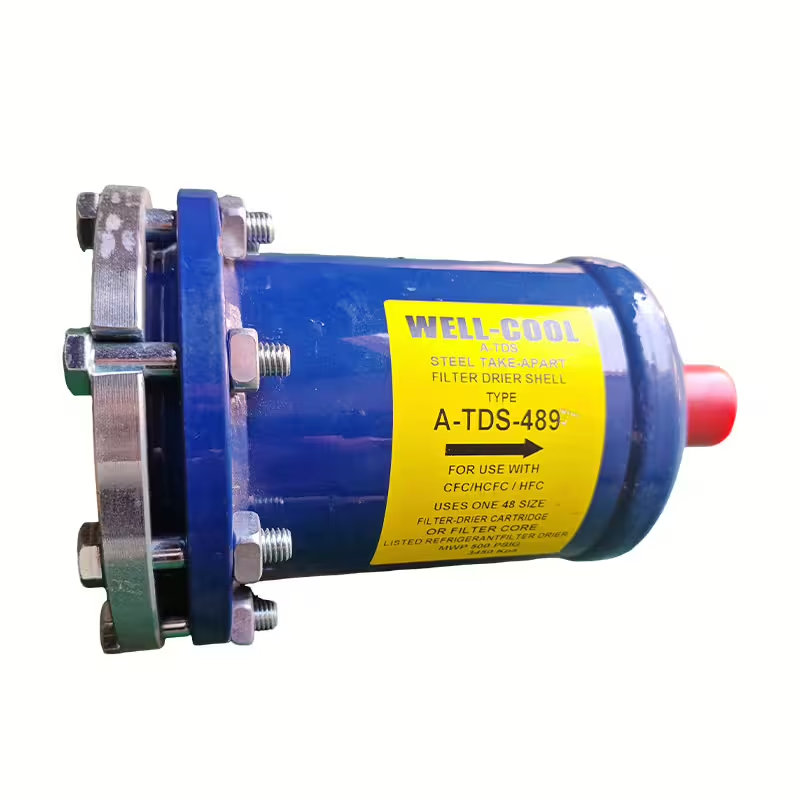
| Replaceable core filter drier | Usually larger refrigeration systems | Allows internal core replacement during maintenance | Industrial refrigeration and larger systems |
| Bi-directional filter drier | Systems with reverse refrigerant flow | Supports flow in two directions | Heat pump or special reversible systems |
A liquid line filter drier is commonly used as standard system protection. A suction line filter drier is often used after compressor burnout or when the system may contain acid and debris. However, suction line pressure drop must be monitored carefully because excessive restriction can affect compressor operation.
Common Applications in Cold Room and Industrial Refrigeration
A refrigeration filter drier can be used in many commercial and industrial cooling systems. Its selection depends on system capacity, refrigerant type, line size, operating pressure, and contamination risk.
Common applications include:
Cold room refrigeration systems
Freezer room systems
Food cold chain warehouses
Supermarket refrigeration
Restaurant and hotel cold storage
Pharmaceutical cold storage
Biopharmaceutical refrigeration
Chemical cooling systems
Industrial process cooling
Air conditioning and refrigeration equipment
For food cold chain applications, temperature stability and system reliability are especially important. The U.S. FDA provides general guidance for safe refrigerated and frozen food storage through its food storage safety information. A clean and stable refrigeration circuit helps support the system performance required for these storage environments.
Moisture: The Hidden Enemy in Refrigeration Systems
Moisture is one of the most damaging contaminants in refrigeration systems. It may enter during installation, pipe brazing, poor vacuuming, component replacement, service work, or through leaks.
Moisture can cause several problems:
Ice formation at the expansion valve
Acid formation inside the refrigerant circuit
Corrosion of internal metal surfaces
Oil degradation
Copper plating
Compressor wear
Unstable cooling performance
Blocked refrigerant flow
In low-temperature systems, moisture can freeze at small openings and restrict refrigerant flow. This may cause poor cooling, abnormal pressure, or intermittent system failure. In severe cases, moisture can contribute to acid formation and compressor damage.
A refrigeration filter drier helps reduce this risk by absorbing moisture before it reaches sensitive system components.
Contaminants That a Filter Drier Helps Remove
Refrigeration systems may contain many types of contaminants, especially after installation, repair, or component failure.
Common contaminants include:
Copper oxide from brazing
Metal particles from compressor wear
Dirt from poor installation practice
Flux residue
Degraded oil particles
Acid after compressor burnout
Moisture from air exposure
Rubber or seal debris
These contaminants may damage expansion valves, solenoid valves, compressors, and other refrigeration components. Rongyi Cold’s thermostatic expansion valves and solenoid valves are important flow-control components, but they need clean refrigerant flow to operate reliably.
A filter drier helps protect these components by trapping unwanted particles before they cause blockage or wear.
How to Choose a Refrigeration Filter Drier
Selecting a refrigeration filter drier requires more than matching the pipe size. Buyers should consider the complete system condition and application requirements.
Important selection factors include:
Refrigerant compatibility
System cooling capacity
Line size
Operating pressure
Installation position
Moisture removal capacity
Filtration ability
Flow direction
Pressure drop
Application temperature
Serviceability
System cleanliness
A filter drier that is too small may create pressure drop or become restricted quickly. A poorly matched filter drier may not provide enough moisture removal or filtration capacity. For industrial refrigeration systems, replaceable core designs may be useful when service access and long-term maintenance are important.
Buyers should also consider whether the system is new, recently repaired, or recovering from compressor failure. A new system may need standard protection, while a contaminated system may need stronger cleanup support.
Signs of a Clogged Refrigeration Filter Drier
A clogged filter drier can restrict refrigerant flow and cause cooling problems. It may appear after system contamination, moisture overload, compressor burnout, poor installation, or long operating time.
Common signs include:
Temperature difference across the filter drier
Frost or sweating near the filter drier
Low suction pressure
High superheat
Poor cooling performance
Expansion valve starvation
Bubbles in the sight glass
Long compressor running time
Pressure drop across the filter drier
If the filter drier is restricted, the evaporator may not receive enough refrigerant. This can reduce cooling capacity and force the compressor to run longer. In severe cases, the system may fail to maintain the required cold room temperature.
A sight glass can help technicians observe refrigerant condition. Rongyi Cold provides SG type sight glass products as part of its refrigeration component range for system monitoring and maintenance support.
Filter Drier and Compressor Protection
The compressor is one of the most valuable components in a refrigeration system. A filter drier helps protect it by reducing moisture and debris in the refrigerant circuit.
Moisture can degrade oil and contribute to acid formation. Solid particles can damage valves, bearings, and moving components. Poor refrigerant flow can create abnormal system pressure and increase operating stress.
For systems using semi hermetic piston compressors or other commercial refrigeration compressors, system cleanliness is especially important because industrial and cold storage equipment often operates for long hours.
A filter drier cannot solve every compressor problem, but it can reduce contamination-related risks. It should be used together with proper evacuation, correct refrigerant charging, suitable oil management, clean installation, and routine maintenance.
Filter Drier and Expansion Valve Performance
The expansion valve controls refrigerant flow into the evaporator. Because the valve contains small passages and sensitive control parts, contamination can easily affect its performance.
A blocked or partially restricted expansion valve may cause:
Evaporator starvation
High superheat
Uneven cooling
Low suction pressure
Poor pull-down performance
Compressor overheating risk
A refrigeration filter drier installed before the expansion valve helps protect the valve from moisture and particles. This is especially important in cold rooms and freezer rooms where stable evaporator feeding affects product temperature and system efficiency.
For systems using evaporator air-coolers, correct refrigerant feeding is essential. Even a well-selected evaporator cannot perform correctly if refrigerant flow is restricted upstream.
Filter Drier Installation Best Practices
Correct installation is important for filter drier performance. A good component can still fail to protect the system if installed incorrectly.
Best practices include:
Install the filter drier in the correct flow direction.
Select the right size for the system capacity.
Avoid overheating during brazing.
Keep the system sealed before installation.
Use proper evacuation procedures.
Replace the filter drier after major service work.
Monitor pressure drop during maintenance.
Install a sight glass when system monitoring is needed.
Do not reuse old filter driers after contamination events.
Follow the system design and service requirements.
During installation, moisture control is critical. Pipes and components should not be left open to air for long periods. After assembly, proper evacuation helps remove air and moisture before refrigerant charging.
For technical background on refrigeration practices and system design, ASHRAE provides industry resources through its refrigeration technical resources.
When Should a Refrigeration Filter Drier Be Replaced?
A refrigeration filter drier is not designed to last forever in every condition. Replacement may be needed after certain service events or when restriction is detected.
Common replacement situations include:
After opening the refrigerant circuit
After compressor replacement
After compressor burnout
After moisture contamination
After severe system leakage
After major component replacement
When pressure drop is excessive
When cooling performance indicates restriction
When the sight glass indicates moisture
During planned maintenance for critical systems
Replacing the filter drier after system service is a common preventive step because the refrigerant circuit may have been exposed to air and moisture. For high-value cold storage or industrial cooling projects, preventive replacement is often safer than waiting for restriction or acid-related problems.
Filter Drier Selection for Different Refrigeration Projects
Different refrigeration systems may need different filter drier priorities.
For cold rooms, the focus is stable refrigerant flow and long-term moisture control.
For freezer rooms, moisture control is especially important because low-temperature operation increases the risk of ice blockage.
For supermarket refrigeration, system reliability matters because one failure may affect multiple display cases or storage areas.
For food processing plants, contamination control and maintenance planning are important because systems may operate under heavy load.
For pharmaceutical storage, system reliability and stable temperature control are critical.
For chemical and industrial cooling systems, filter drier selection may depend on system size, operating condition, refrigerant, and service accessibility.
For larger systems, replaceable core filter driers may be useful because maintenance teams can replace internal cores without changing the whole shell.
How Filter Driers Work With Other Refrigeration Components
A refrigeration filter drier should be considered as part of a complete protection system. It works together with other components to support stable refrigeration operation.
| Component | Role in the System | Relationship With Filter Drier |
| Compressor | Circulates refrigerant | Needs clean refrigerant and good oil condition |
| Condenser | Rejects heat | Sends liquid refrigerant toward the liquid line |
| Filter drier | Removes moisture and contaminants | Protects downstream components |
| Sight glass | Shows refrigerant condition | Helps identify moisture or flow issues |
| Solenoid valve | Controls refrigerant flow | Needs clean refrigerant to prevent sticking |
| Expansion valve | Meters refrigerant into evaporator | Needs clean liquid refrigerant |
| Evaporator | Absorbs heat from cold room | Needs stable refrigerant feeding |
Rongyi Cold’s product center includes compressors, condensing units, evaporators, condensers, and refrigeration components for complete commercial and industrial cooling systems. For B2B projects, these parts should be selected as a coordinated system.
Common Buyer Mistakes to Avoid
Many filter drier problems happen because the component is treated as an afterthought.
Selecting only by pipe diameter
Pipe size matters, but system capacity, refrigerant type, pressure drop, and moisture capacity also matter.
Ignoring refrigerant compatibility
A filter drier must be suitable for the refrigerant and oil used in the system.
Reusing old filter driers
Old filter driers may already be saturated with moisture or contaminated with debris.
Skipping replacement after service
Opening the refrigeration circuit can introduce moisture and air. Replacement is often needed after major service.
Ignoring pressure drop
A restricted filter drier can reduce refrigerant flow and cause poor cooling.
Installing in the wrong direction
Many filter driers have a specified flow direction. Wrong installation can reduce performance or create restriction.
Focusing only on major equipment
Compressors and condensers are important, but small components often protect the entire system.
Inquiry Checklist for Refrigeration Filter Drier Selection
Before requesting a quotation, buyers should prepare basic system information. This helps the supplier recommend a suitable filter drier and related components.
| Information Needed | Why It Matters |
| Refrigerant type | Determines compatibility |
| System capacity | Helps select proper size |
| Line size | Ensures correct connection |
| Application | Cold room, freezer room, supermarket, industrial cooling |
| Installation position | Liquid line, suction line, or replaceable core shell |
| Operating pressure | Must match component rating |
| System condition | New installation, repair, burnout cleanup, or maintenance |
| Flow direction | Important for correct installation |
| Required serviceability | Determines sealed or replaceable core type |
| Related components | Sight glass, solenoid valve, expansion valve, compressor |
Buyers can send system details through Rongyi Cold’s contact page to receive a more suitable refrigeration component recommendation.
How to Evaluate a Refrigeration Components Supplier
A reliable refrigeration components supplier should understand how small parts affect the complete system. The supplier should not only provide a filter drier model but also help buyers confirm compatibility with refrigerant, system capacity, pressure level, and application conditions.
Useful evaluation questions include:
Does the supplier provide filter driers and related system components?
Can the supplier support commercial and industrial refrigeration projects?
Does the supplier understand cold room and freezer room applications?
Can the supplier recommend matching components such as sight glasses and expansion valves?
Can the supplier support OEM or project-based purchasing?
Are product categories clear and easy to match with system needs?
Does the supplier provide technical communication before ordering?
For overseas buyers, distributors, and refrigeration contractors, component consistency and supplier support can reduce project risk.
Conclusion
A refrigeration filter drier is a small component with a large impact on refrigeration system reliability. It helps remove moisture, trap contaminants, protect compressors, support expansion valve operation, and maintain clean refrigerant flow.
For cold rooms, freezer rooms, food cold chain systems, supermarket refrigeration, pharmaceutical storage, chemical cooling, and industrial refrigeration projects, choosing the right filter drier can prevent many avoidable problems. Buyers should consider refrigerant compatibility, system capacity, installation position, pressure drop, moisture removal capacity, and maintenance requirements.
Rongyi Cold provides refrigeration components, compressors, condensing units, evaporators, and condensers for commercial and industrial refrigeration systems. To select a suitable refrigeration filter drier or complete component solution, send your system requirements through the contact page.
FAQ
What does a refrigeration filter drier do?
A refrigeration filter drier removes moisture and filters solid contaminants from the refrigerant circuit. It helps protect compressors, expansion valves, solenoid valves, and other refrigeration components.
Where is a refrigeration filter drier installed?
It is commonly installed in the liquid line before the expansion valve. In some service situations, a suction line filter drier may also be installed to protect the compressor after contamination or burnout.
How do I know if a filter drier is clogged?
Common signs include temperature difference across the filter drier, frost near the component, low suction pressure, poor cooling performance, high superheat, and pressure drop across the drier.
Should a filter drier be replaced after opening the system?
Yes, it is often recommended to replace the filter drier after opening the refrigeration circuit because air and moisture may enter during service or component replacement.
Can a filter drier protect the compressor?
Yes. A filter drier helps reduce moisture and contaminants that may damage the compressor, degrade oil, create acid, or affect refrigerant flow. It is an important part of compressor protection.
