

A semi hermetic piston compressor is one of the most widely used compressor types in commercial and industrial refrigeration systems. For cold rooms, freezer rooms, food processing facilities, supermarket refrigeration, pharmaceutical storage, chemical cooling, and industrial process cooling, the compressor is the core component that drives refrigerant circulation and determines much of the system’s cooling stability.
Many buyers focus first on the cold room size, evaporator model, or condensing unit appearance. However, the compressor is often the part that decides whether the system can operate reliably under real working conditions. A poorly selected compressor may lead to unstable temperature, high discharge temperature, frequent shutdowns, poor energy performance, and higher maintenance pressure.
This guide explains how a semi hermetic piston compressor works, when it is suitable, what buyers should check before ordering, and how to match it with condensers, evaporators, and complete refrigeration systems.
Table of Contents
What Is a Semi Hermetic Piston Compressor?
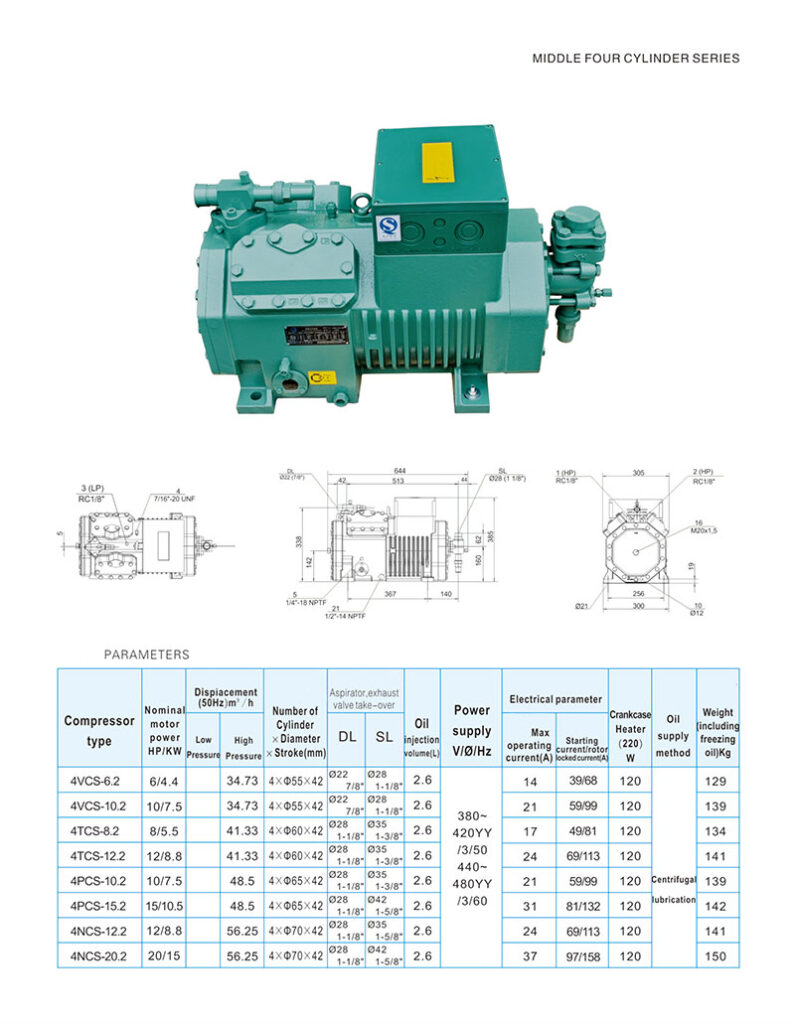
A semi hermetic piston compressor is a refrigeration compressor with a bolted housing that can be opened for service. Inside the compressor, pistons move within cylinders to compress refrigerant vapor. Compared with a fully sealed compressor, a semi hermetic design allows easier inspection and maintenance of internal parts when service is required.
In a refrigeration system, the compressor draws low-pressure refrigerant vapor from the evaporator and compresses it into high-pressure, high-temperature vapor. This vapor then flows to the condenser, where heat is rejected from the system.
For a general technical background, vapor-compression refrigeration explains the basic cycle used in many commercial and industrial refrigeration systems. In real cold storage projects, the compressor must be selected according to temperature range, cooling load, refrigerant type, installation condition, and operating schedule.
Rongyi Cold provides compressor products for refrigeration systems, including compressor options used in commercial refrigeration, cold storage, and industrial cooling applications.
Why Semi Hermetic Piston Compressors Are Used in Cold Storage Projects
Semi hermetic piston compressors remain common in refrigeration projects because they offer a strong balance of serviceability, application flexibility, and stable performance. They are especially suitable for projects where the refrigeration system may operate for long hours or where maintenance access matters.
A semi hermetic piston compressor is often considered for:
Cold rooms
Freezer rooms
Food cold chain warehouses
Meat and seafood storage
Supermarket refrigeration
Industrial process cooling
Chemical cooling systems
Pharmaceutical cold storage
Large commercial refrigeration systems
One major advantage is serviceability. Because the housing can be opened, technicians may inspect or replace certain internal parts instead of replacing the entire compressor immediately. For industrial and commercial buyers, this can be important in projects where downtime must be reduced and maintenance planning matters.
How a Semi Hermetic Piston Compressor Works
A semi hermetic piston compressor uses reciprocating motion to compress refrigerant vapor. The piston moves down to draw refrigerant vapor into the cylinder, then moves up to compress the vapor and discharge it at higher pressure.
The simplified process includes:
Refrigerant vapor enters the suction side.
The piston draws vapor into the cylinder.
The piston compresses the refrigerant.
The compressed vapor exits through the discharge side.
The refrigerant flows toward the condenser.
This process repeats continuously during compressor operation. Because the compressor works under pressure and temperature changes, correct system matching is essential. Improper evaporating temperature, poor condenser heat rejection, incorrect refrigerant charge, or weak oil return may all affect compressor reliability.
Rongyi Cold’s compression condensing units integrate compressor, condenser, and control components for cold storage and industrial refrigeration systems. For many buyers, selecting a compressor as part of a complete condensing unit is easier than purchasing separate components without technical matching.
Semi Hermetic Piston Compressor vs Fully Hermetic Compressor
Buyers often compare semi hermetic piston compressors with fully hermetic compressors. Both are used in refrigeration, but they are designed for different service and application needs.
| Comparison Factor | Semi Hermetic Piston Compressor | Fully Hermetic Compressor |
|---|---|---|
| Housing structure | Bolted and serviceable | Fully sealed |
| Maintenance | Internal inspection may be possible | Usually replaced as a sealed unit |
| Application range | Medium to large commercial and industrial refrigeration | Smaller commercial systems and compact units |
| Serviceability | Higher | Lower |
| Installation flexibility | Often stronger for project-based systems | Often used in compact packaged equipment |
| Common use | Cold storage, freezer rooms, industrial refrigeration | Small refrigeration units and lighter-duty systems |
| Buyer focus | Long-term operation and maintenance access | Compactness and simple replacement |
A fully hermetic compressor may be suitable for compact refrigeration equipment. A semi hermetic piston compressor is often more suitable when the project requires higher serviceability, stronger application flexibility, and long-term maintenance planning.
For buyers comparing different system configurations, Rongyi Cold’s product center provides access to compressors, condensing units, evaporators, condensers, and refrigeration components used in complete refrigeration systems.
When Should You Choose a Semi Hermetic Piston Compressor?
A semi hermetic piston compressor may be a good choice when the refrigeration project has demanding operation, medium or low-temperature requirements, or long service expectations.
It is commonly considered when:
The cold room operates for long hours.
The project requires medium or low-temperature refrigeration.
Maintenance access is important.
The system serves food cold chain storage.
The application involves freezer room operation.
The refrigeration load is relatively high.
The system requires stable cooling under changing load.
The buyer wants serviceable compressor construction.
The project is industrial or commercial rather than light-duty household refrigeration.
For food storage and cold chain applications, temperature stability is especially important. The U.S. FDA provides general guidance for refrigerated and frozen food storage on its official safe food storage page. A properly selected compressor helps support stable storage conditions when matched with the correct evaporator, condenser, and controls.
Main Applications of Semi Hermetic Piston Compressors
Semi hermetic piston compressors can support different commercial and industrial refrigeration applications. However, each application has different system requirements.
Cold Room Refrigeration
Cold rooms need stable temperature control, reliable compressor operation, and suitable capacity matching. The compressor must match the room load, evaporator capacity, condenser heat rejection, and operating schedule.
Freezer Room Refrigeration
Freezer rooms usually operate at lower evaporating temperatures. This places more stress on the compressor, so compressor selection should consider low-temperature performance, oil return, discharge temperature, and defrost influence.
Food Processing Facilities
Food processing areas may require frequent cooling recovery due to door openings, product loading, worker activity, and processing heat. The compressor must support reliable operation under variable load.
Supermarket Refrigeration
Supermarket refrigeration systems may include cold rooms, display cabinets, freezer storage, and back-room cooling. Compressor reliability is important because system downtime can affect multiple refrigerated areas.
Pharmaceutical and Chemical Cooling
Pharmaceutical and chemical applications may require stable temperature control and continuous operation. Equipment selection should focus on reliability, control accuracy, and maintenance accessibility.
Compressor Capacity: Why Correct Sizing Matters
A semi hermetic piston compressor must be sized according to the actual refrigeration load. Selecting by horsepower alone can be misleading because compressor performance depends on evaporating temperature, condensing temperature, refrigerant type, and application condition.
An undersized compressor may cause:
Slow pull-down
Long running time
Unstable room temperature
Poor recovery after loading
Increased mechanical stress
A compressor that is too large may cause:
Frequent cycling
Poor system balance
Reduced efficiency
Oil return problems
Unstable control behavior
Capacity selection should consider:
Room size
Target temperature
Product type
Daily loading quantity
Product entry temperature
Door opening frequency
Evaporator capacity
Condenser performance
Ambient temperature
Required cooling recovery time
The compressor should not be selected as a standalone component. It must be matched with the whole refrigeration system.
Matching the Compressor With the Condenser
The condenser must reject the heat generated by the refrigeration system. If the condenser is too small, dirty, or poorly ventilated, the compressor may operate at high condensing pressure. This can increase discharge temperature, reduce efficiency, and shorten compressor life.
For air cooled systems, condenser airflow is critical. For water cooled systems, water flow and water quality are critical. Rongyi Cold provides both condenser products and a shell and tube water-cooled condenser for different refrigeration project requirements.
Important condenser matching factors include:
Heat rejection capacity
Ambient temperature
Water inlet temperature for water cooled systems
Airflow or water flow condition
Refrigerant compatibility
Working pressure
Installation location
Cleaning access
Maintenance plan
A good compressor selection can still fail if the condenser cannot reject heat effectively. Compressor and condenser matching should be reviewed together during system design.
Matching the Compressor With the Evaporator
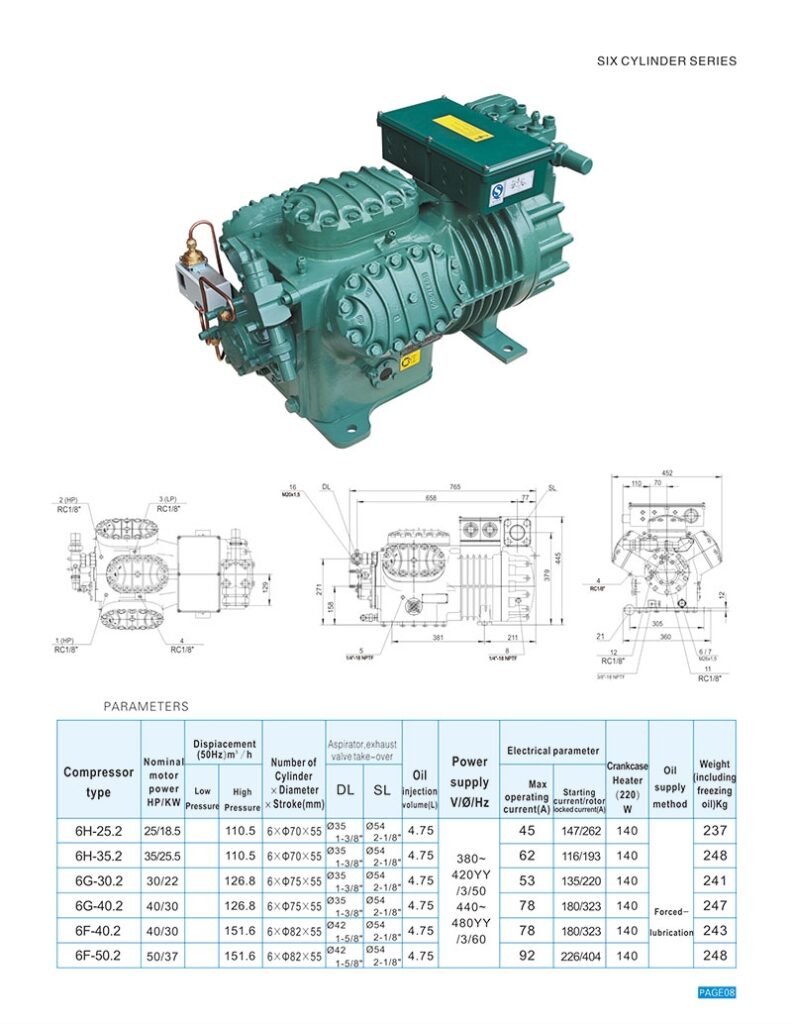
The evaporator absorbs heat from the cold room or cooling area. If the evaporator is not properly matched with the compressor, the system may suffer from poor cooling, unstable suction pressure, excessive frost, or inefficient operation.
Rongyi Cold supplies evaporator air-cooler products for cold storage, commercial refrigeration, and industrial cooling applications. The evaporator should match the compressor capacity, application temperature, refrigerant type, airflow requirement, and defrost method.
Key evaporator matching factors include:
Cooling capacity
Evaporating temperature
Airflow volume
Fin spacing
Defrost method
Room layout
Product loading
Refrigerant type
Expansion valve selection
Drainage design
In freezer rooms, defrost performance is especially important because frost buildup can reduce airflow and lower heat transfer efficiency. If evaporator performance drops, compressor operating time may increase and the system may become less stable.
Refrigeration Components That Protect Compressor Operation
A semi hermetic piston compressor depends on several supporting refrigeration components for stable operation. These components help manage refrigerant flow, remove contaminants, monitor system condition, reduce vibration, and protect the compressor.
Rongyi Cold’s refrigeration components include sight glasses, pressure gauges, filter driers, solenoid valves, thermostatic expansion valves, drying filter cartridges, vibration-damping hoses, and check valves.
| Component | Main Function | Why It Matters for Compressor Protection |
| Filter drier | Removes moisture and impurities | Helps prevent blockage, corrosion, and compressor damage |
| Sight glass | Shows refrigerant condition | Helps technicians inspect flow and moisture indication |
| Solenoid valve | Controls refrigerant flow | Supports system control and shutdown protection |
| Expansion valve | Regulates refrigerant into evaporator | Helps maintain proper evaporator feeding |
| Pressure gauge | Monitors operating pressure | Helps diagnose high or low pressure issues |
| Vibration-damping hose | Reduces vibration transmission | Helps protect piping and connections |
| Check valve | Prevents reverse flow | Helps maintain correct refrigerant direction |
These components may look small compared with the compressor, but they play a major role in long-term system reliability.
Common Problems in Semi Hermetic Piston Compressors
Semi hermetic piston compressors are durable when properly selected and maintained, but problems can occur if the system is poorly designed or operated.
High Discharge Temperature
High discharge temperature may be caused by high compression ratio, poor condenser heat rejection, incorrect refrigerant charge, low suction pressure, or insufficient cooling.
Compressor Overheating
Overheating may result from poor ventilation, high condensing pressure, inadequate oil return, electrical problems, or long operation under heavy load.
Liquid Slugging
Liquid slugging happens when liquid refrigerant enters the compressor. This can damage internal components because compressors are designed to compress vapor, not liquid.
Poor Oil Return
Poor oil return can cause lubrication problems. It may be related to piping design, refrigerant velocity, system load, or evaporator operation.
High Vibration
Vibration may come from mechanical imbalance, piping stress, poor mounting, or system resonance. Vibration-damping components can help reduce stress on pipelines.
Frequent Start and Stop
Frequent cycling can increase wear and may indicate poor capacity matching, control problems, oversized equipment, or unstable load conditions.
Low Cooling Capacity
Low capacity may result from refrigerant shortage, poor compressor performance, dirty condenser, blocked filter drier, expansion valve issues, or evaporator airflow problems.
Maintenance Checklist for Semi Hermetic Piston Compressors
Maintenance planning is essential for long-term compressor reliability. A compressor may operate under demanding conditions for many hours each day, so regular inspection helps prevent small issues from becoming major failures.
A practical maintenance checklist includes:
Check suction and discharge pressure.
Monitor compressor running temperature.
Inspect oil level and oil condition.
Check for abnormal vibration or noise.
Inspect electrical terminals and wiring.
Check refrigerant charge condition.
Inspect filter drier condition.
Clean condenser surfaces.
Check evaporator airflow and frost condition.
Inspect mounting bolts and vibration control.
Check for refrigerant leakage.
Review temperature control settings.
Maintenance frequency depends on the application. A supermarket cold room may have different inspection needs from a chemical cooling system or a seafood freezer room. For heavy-duty industrial refrigeration, maintenance should be part of the operating plan from the beginning.
Energy Efficiency Depends on System Matching
Energy efficiency is not only about selecting a high-quality compressor. It depends on system design and operating conditions. A semi hermetic piston compressor can perform well when matched with the correct condenser, evaporator, expansion valve, controls, and refrigerant charge.
ASHRAE provides refrigeration technical resources related to refrigerated facilities, refrigeration systems, and application design through its refrigeration resources. For buyers, the key lesson is that refrigeration performance depends on the full system rather than one component alone.
Efficiency can be improved by:
Correct compressor sizing
Clean condenser heat exchange surfaces
Proper evaporator capacity
Accurate expansion valve selection
Stable refrigerant charge
Good insulation
Reduced door opening loss
Correct defrost settings
Routine maintenance
Proper control strategy
An oversized compressor does not automatically save energy. An undersized compressor may run too long. The best solution is a correctly matched compressor operating within a stable system design.
How to Select a Semi Hermetic Piston Compressor for Your Project
Before selecting a compressor, buyers should prepare project information. This helps the supplier recommend a suitable model and avoid wrong selection.
| Information Needed | Why It Matters |
| Application type | Determines refrigeration requirements |
| Cold room size | Helps estimate cooling load |
| Target temperature | Determines medium or low-temperature compressor selection |
| Product type | Affects cooling speed and storage condition |
| Daily loading quantity | Influences pull-down demand |
| Product entry temperature | Warm products require more cooling capacity |
| Condenser type | Affects condensing temperature and compressor operation |
| Evaporator capacity | Must match compressor output |
| Refrigerant type | Must match system design |
| Power supply | Determines electrical compatibility |
| Installation environment | Affects ventilation, heat rejection, and maintenance |
| Operating hours | Important for durability and maintenance planning |
For project-based selection, buyers can send these details through Rongyi Cold’s contact page to receive a more suitable compressor recommendation.
Semi Hermetic Piston Compressor in Condensing Units
Many buyers purchase compressors as part of a condensing unit rather than as a separate component. This can reduce matching risks because the compressor, condenser, frame, fan, controls, and protection components can be configured together.
A semi hermetic piston compressor may be used in different condensing unit structures depending on the project, such as open-type air cooled units, water cooled condenser units, or box type cooling units.
Rongyi Cold offers an open-type air-cooled unit for refrigeration applications requiring efficient heat rejection and stable operation. For projects where water-based heat rejection is preferred, the water cooler condenser unit can support applications such as food, medical machinery, biopharmaceutical, and chemical refrigeration.
Choosing a compressor within a complete condensing unit can help buyers simplify installation planning and improve system compatibility.
Buyer Mistakes to Avoid
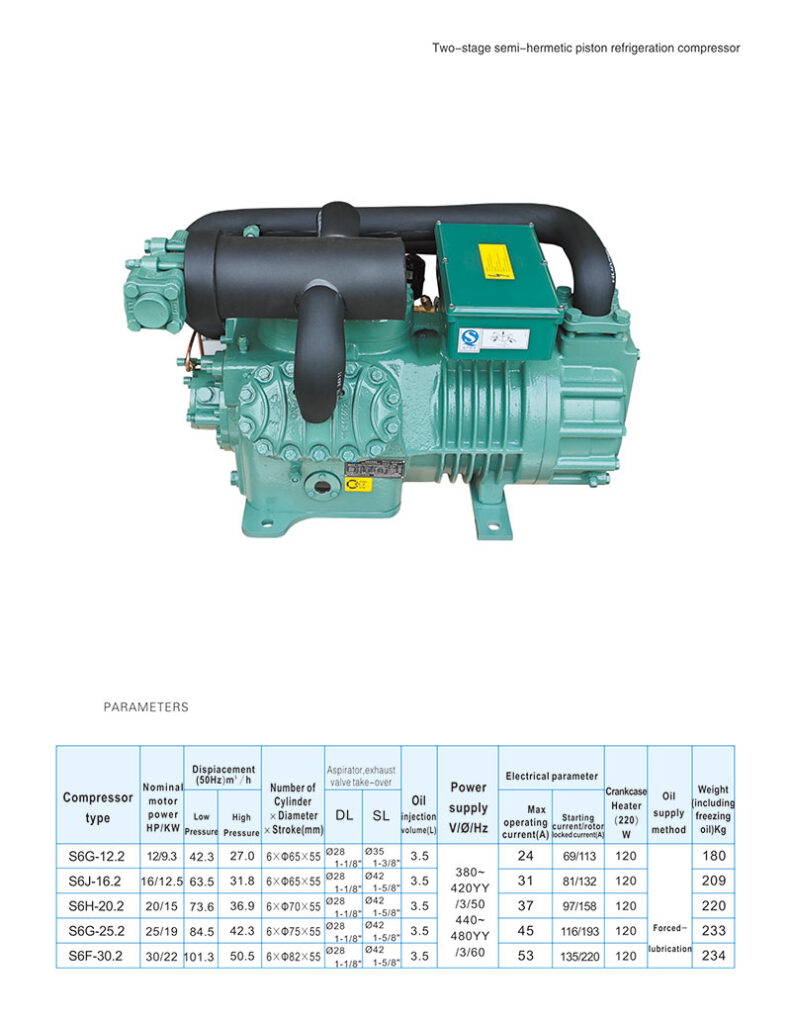
Many compressor problems begin during purchasing. Avoiding common mistakes can reduce system risk and improve long-term performance.
Selecting only by horsepower
Horsepower does not fully describe cooling capacity. Compressor performance depends on operating temperature, refrigerant, condensing condition, and evaporating condition.
Ignoring application temperature
A compressor for medium-temperature refrigeration may not be suitable for low-temperature freezer operation.
Forgetting condenser capacity
Poor condenser heat rejection can cause high pressure and compressor overheating.
Ignoring evaporator matching
A mismatched evaporator can cause unstable suction pressure, poor airflow, frost problems, and weak cooling.
Choosing without maintenance planning
Semi hermetic compressors are serviceable, but only if technicians have enough access and the system is designed for inspection.
Ignoring supporting components
Filter driers, expansion valves, pressure gauges, sight glasses, and vibration control components all affect compressor reliability.
Sending incomplete inquiry information
A supplier cannot recommend the right compressor if the buyer only provides cold room volume without product load, temperature, and operating details.
How to Evaluate a Compressor Supplier
A professional compressor supplier should not only provide a model number. They should ask about the system and explain why the recommended compressor fits the project.
Important evaluation questions include:
Does the supplier ask about target temperature?
Does the supplier ask about refrigerant type?
Does the supplier check condenser and evaporator matching?
Does the supplier understand cold room and freezer room applications?
Does the supplier provide related refrigeration components?
Can the supplier support condensing unit configuration?
Can the supplier help with project-based selection?
Is maintenance access considered?
Is technical support available?
For B2B buyers, supplier communication quality is part of product quality. A compressor must operate inside a real refrigeration system, so technical support matters before and after purchase.
Conclusion
A semi hermetic piston compressor is a reliable and serviceable compressor choice for cold storage, freezer rooms, food cold chain, supermarket refrigeration, pharmaceutical storage, chemical cooling, and industrial refrigeration systems. Its strong application flexibility and maintainable structure make it suitable for many commercial and industrial projects.
However, the compressor must be selected as part of the complete refrigeration system. Buyers should consider cooling load, target temperature, refrigerant type, condenser performance, evaporator capacity, supporting components, installation environment, and maintenance planning.
Rongyi Cold provides compressors, compression condensing units, evaporators, condensers, and refrigeration components for commercial and industrial refrigeration projects. To select a suitable semi hermetic piston compressor or complete refrigeration solution, send your project details through the contact page.
FAQ
What is a semi hermetic piston compressor?
A semi hermetic piston compressor is a serviceable refrigeration compressor with a bolted housing and reciprocating pistons that compress refrigerant vapor. It is commonly used in cold storage, freezer rooms, and industrial refrigeration systems.
Where is a semi hermetic piston compressor used?
It is used in cold rooms, freezer rooms, food cold chain warehouses, supermarket refrigeration, pharmaceutical storage, chemical cooling, and industrial refrigeration projects.
Is a semi hermetic piston compressor easy to maintain?
Compared with fully sealed compressors, a semi hermetic design offers better serviceability because the housing can be opened for inspection and maintenance by qualified technicians.
How do I choose the right semi hermetic piston compressor?
You should consider cooling load, target temperature, refrigerant type, condenser capacity, evaporator capacity, product loading, operating hours, power supply, and installation environment.
Can a semi hermetic piston compressor be used in a condensing unit?
Yes. It can be used as part of a condensing unit when matched with the correct condenser, controls, protection components, and refrigeration system design.
