

Table of Contents
An air cooled condenser must reject more heat than the evaporator absorbs. It also rejects heat added by the compressor, so selecting a coil from cold-room cooling load alone can leave the system short of capacity on the hottest design day. The result may be high condensing pressure, reduced compressor capacity, higher energy use, and protective shutdowns.
A reliable air cooled condenser selection starts with total heat rejection at a declared refrigerant and operating point. It then tests that rating against design ambient temperature, airflow resistance, hot-air recirculation, refrigerant pressure drop, fan control, noise, corrosion exposure, and service access. This guide presents that process as a project worksheet rather than a single catalog lookup.
Calculate Total Heat Rejection Before Opening a Catalog
The condenser rejects the refrigeration load plus the heat equivalent of compressor input. In engineering terms, total heat rejection is established from the evaporator duty and compressor performance at the selected suction and condensing conditions. The exact compressor contribution changes with refrigerant, compression ratio, efficiency, and operating point; it should not be replaced by an unexplained universal percentage.
Use the project load calculation, compressor performance data, and system balance. The condensing unit and evaporator matching guide explains why components must be evaluated at a common condition. An air cooled condenser chosen against an optimistic evaporator number may not match the compressor that is actually installed.

Set the Design Ambient at the Coil Inlet
Weather-station temperature is not always the temperature entering an air cooled condenser. Rooftop solar gain, an enclosed yard, nearby kitchen exhaust, multiple condensers, and a wall that traps discharge air can raise the inlet condition. Specify the highest credible coil-entering dry-bulb temperature for the operating requirement and local design basis.
Also decide what must happen beyond that point. A system may need full capacity at design ambient and controlled operation during a short extreme, rather than full performance at every imaginable temperature. Document the assumption. The weather basis, location, elevation, and safety margin should be reviewable by the buyer and designer, not hidden inside the air cooled condenser model choice.
Choose a Condensing Temperature Deliberately
Heat transfer depends on the temperature difference between condensing refrigerant and entering air. A larger difference can make the air cooled condenser physically smaller, but it raises compressor lift and can reduce system efficiency and capacity. A smaller difference generally needs more coil surface or airflow. This is an operating tradeoff, not simply a purchasing preference.
Establish the saturated condensing temperature used for the rating, then account for refrigerant pressure drop between the compressor discharge and condenser outlet. Use consistent dew, bubble, or mean-temperature conventions where refrigerant glide is relevant. Authoritative property tools such as NIST REFPROP support refrigerant calculations, and the ASHRAE Handbook provides broader refrigeration design references. The air cooled condenser rating and compressor data must share a defensible basis.
Protect Airflow From Real-World Resistance
Catalog airflow is only useful if the installed air cooled condenser can move air through its actual path. Screens, louvers, close walls, dirt loading, packaging left in place, snow barriers, and acoustic treatments add resistance. A fan selected for an open test condition may deliver less airflow after installation.
Check fan type, quantity, motor supply, speed-control compatibility, and available external static pressure. Confirm the air discharge direction and keep the inlet free of obstructions. If guards or field ductwork are planned, obtain performance at the resulting resistance. Never assume that increasing fan speed is a harmless correction; it changes noise, motor load, airflow, and coil performance. The EPA equipment-management guidance provides additional context for responsible operation and refrigerant service.
Prevent Hot Discharge Air From Returning
Hot-air recirculation raises the effective inlet temperature and can make an adequately rated air cooled condenser behave like an undersized one. It occurs when discharge air strikes a wall, canopy, parapet, or adjacent unit and loops back to the coil face. Wind can make the pattern intermittent, which explains why head pressure may be normal during one inspection and high later.
Lay out clear intake and discharge zones using the equipment requirements, not a generic clearance copied between projects. Consider prevailing wind, building geometry, future equipment, and whether several units may operate simultaneously. A smoke study or temperature traverse can help diagnose a suspected problem. Compare coil-inlet temperature with undisturbed ambient while the air cooled condenser is fully loaded.
Match Coil Construction to the Site
Fin spacing affects heat-transfer area, cleanability, and sensitivity to blockage. Dense fins can provide compact performance in clean air but may foul quickly where cottonwood, grease, dust, or frost is present. Tube and fin materials, coatings, casing, fasteners, and fan components should suit coastal salt, industrial contaminants, or other corrosive exposure.
Do not describe a coating as universally protective. Ask what environment it is intended for, how its performance is documented, whether cut edges and fasteners are protected, and how cleaning should be performed. An air cooled condenser that cannot be cleaned without damaging its surface is a poor operational fit even if its initial thermal rating is sufficient.
| Selection input | Question to answer | Consequence if omitted |
|---|---|---|
| Total heat rejection | What must be rejected at the selected suction and condensing point? | High head pressure or unstable system balance |
| Coil-entering ambient | What air temperature will the coil actually receive? | Capacity shortfall during hot or recirculating conditions |
| Temperature difference | Which condensing temperature supports efficiency and coil size goals? | Hidden compressor-energy penalty |
| Air path resistance | Will screens, walls, louvers, or ductwork reduce airflow? | Lower field airflow than rated |
| Refrigerant circuit | Is pressure drop and velocity acceptable across the operating range? | Poor capacity, charge distribution, or oil return |
| Low-ambient plan | How will condensing pressure be controlled in cold weather? | Unstable expansion-device feeding |
| Maintenance envelope | Can staff isolate, clean, and service fans and coils safely? | Rapid fouling and extended downtime |
Review Refrigerant Circuiting and Pressure Drop
An air cooled condenser is also a refrigerant pressure vessel and flow path. Circuit quantity and geometry must accommodate the design mass flow without excessive discharge-side pressure loss, poor distribution, or unreliable oil transport. A selection that is thermally adequate at full load may behave poorly when capacity control reduces refrigerant flow.
Confirm refrigerant compatibility, maximum allowable pressure, design pressure, connection sizes, circuit orientation, receiver arrangement, and expected pressure drop. Evaluate the full operating envelope, including staged compressors or variable capacity. The cold-room condensing unit guide helps connect the air cooled condenser decision to receiver, compressor, and control selection.
Plan Low-Ambient Operation Before Winter
When outdoor temperature falls, an air cooled condenser can reject heat so easily that condensing pressure becomes too low for stable liquid delivery and expansion-device operation. Fan cycling, fan-speed control, flooded-condenser strategies, or other approved methods may be used depending on the system. Each method changes controls, refrigerant charge behavior, and service requirements.
Define the minimum operating ambient, required head-pressure range, fan staging logic, sensor location, and failure response. Avoid controls that cause rapid fan cycling or large pressure swings. Coordinate the chosen strategy with the cold-room evaporator selection guide, because unstable liquid supply can appear as an evaporator or expansion-valve problem even when the root cause is at the air cooled condenser.
Design for Sound, Cleaning, and Safe Access
Fan sound can determine whether an air cooled condenser is acceptable near offices, residences, or property boundaries. Review sound data at the intended fan speed and operating mode, then consider reflections from walls and multiple-unit operation. Noise mitigation that blocks airflow can create a thermal problem, so acoustic and heat-rejection design must be coordinated.
Leave access to isolate power, remove guards, service motors, clean both sides of the coil, inspect refrigerant joints, and clear drainage paths. Follow site hazardous-energy procedures; the OSHA lockout/tagout standard describes control of hazardous energy. Cleaning methods should follow the coil documentation, because excessive pressure or incompatible chemicals can damage fins and coatings. Service access must remain usable after the air cooled condenser is surrounded by final site equipment.
Turn the Selection Into a Reviewable Submittal
A useful air cooled condenser submittal states the refrigerant, total heat rejection, suction and condensing basis, entering-air temperature, elevation, airflow, fan power supply, refrigerant pressure drop, circuit quantity, design and allowable pressures, materials, sound data, dimensions, weight, clearances, and low-ambient controls. It should show which values are rated and which are project assumptions.
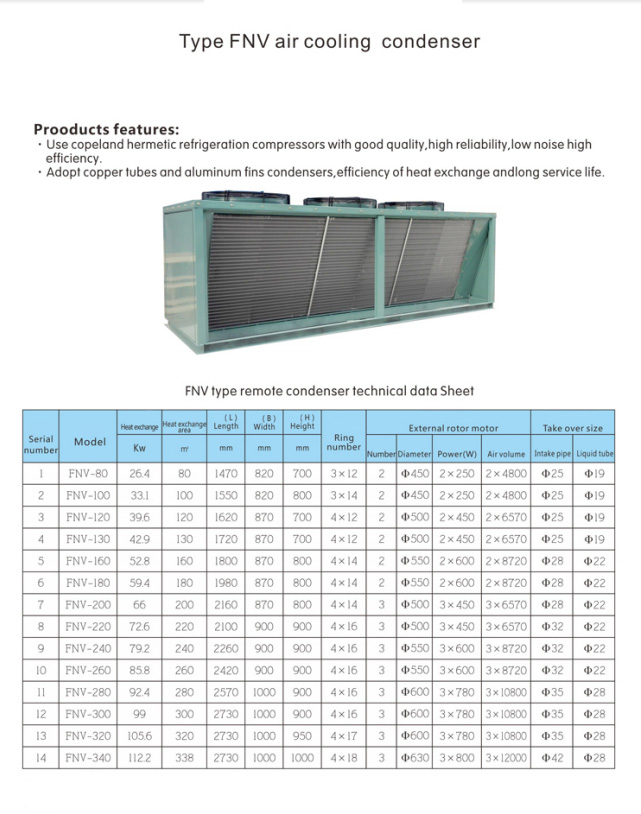
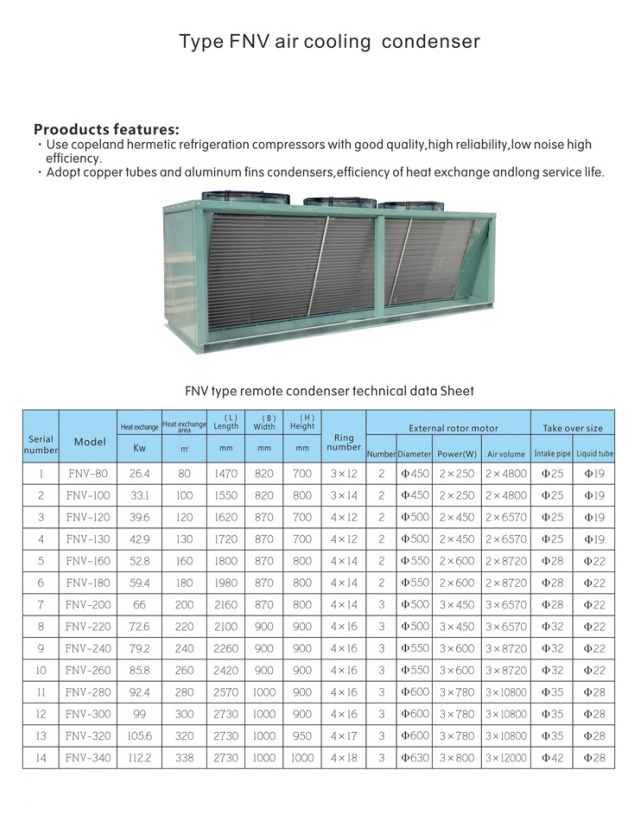
For the available FNV air cooling condenser, request model-specific performance rather than inferring capacity from photographs or cabinet dimensions. Send the project inputs through the Rongyi Cold contact page. The team can then review whether the air cooled condenser is suitable for the required duty and site conditions.

Frequently Asked Questions
Is evaporator capacity enough to size the condenser?
No. An air cooled condenser must reject evaporator load plus compressor heat at the selected operating point. Use matched compressor and evaporator performance.
Which ambient temperature should be used?
Use the project design basis and the credible temperature entering the coil, including site heat and recirculation effects. Do not size an air cooled condenser from an unrelated weather average.
Does a higher condensing temperature reduce condenser size?
It can increase the available temperature difference, but it also raises compressor lift and can hurt efficiency and capacity. Select the air cooled condenser and compressor as a system, then document the air cooled condenser rating point.
Why does head pressure rise only on some days?
Changing wind, fouling, fan control, hot-air recirculation, or high coil-inlet temperature can create intermittent symptoms. Measure conditions at the air cooled condenser during the event.
What information should be sent for a quotation?
Provide refrigerant, total heat rejection, suction and condensing conditions, design ambient, elevation, power supply, sound target, corrosion exposure, low-ambient requirement, layout, and service clearances for the air cooled condenser. A complete schedule keeps air cooled condenser selection tied to the H1 question: safe heat rejection for the actual cold room.
