

Table of Contents
Compressor short cycling is repeated starting and stopping before the refrigeration system reaches a stable operating state. The stop may come from a thermostat, pressure control, motor protection, phase monitor, oil protection, controller logic, or external interlock. The first diagnostic question is not “what pressure is wrong?” but “which device ordered or caused this stop?”
A disciplined compressor short cycling investigation timestamps each start and stop, identifies the initiating control, and then tests the system condition behind that control. Anti-short-cycle delay protects the compressor while diagnosis proceeds, but it cannot repair a restriction, failed fan, unstable sensor, capacity mismatch, or unsafe protection setting. Define how room temperature will be protected during the investigation.
Capture One Complete Start-to-Stop Event
Record start command, suction and discharge pressures, temperatures, current, fan and valve states, room demand, controller inputs, and the exact stop time. Preserve alarm history and protection indicators. Compressor short cycling often becomes obvious when the event sequence is written in seconds rather than summarized later as “it tripped.”
Do not reset controls before reading them. If the compressor stops normally on temperature, the branch differs from a low-pressure, high-pressure, or overload stop. The compressor guide provides operating context, while model-specific controls define permitted starts and delays.

Name the Device That Opens the Run Circuit
Trace the wiring or controller cause-and-effect from the motor contactor backward. Check thermostat output, low- and high-pressure contacts, oil control, motor protection, phase monitor, safety relay, network command, and door or process interlocks. Compressor short cycling cannot be assigned to a sensor until its input is shown to change the run command.
Measure input and output states at the moment of stopping. A controller may display the last alarm rather than the first cause. If several protections cascade, use timestamps or trend resolution to identify the initial event.
Test the Pressure-Control Differential and Sensing Point
Verify cut-in, cut-out, differential, manual or automatic reset, sensing location, and calibration. A low-pressure control used for pump-down should stop the compressor after the liquid-line solenoid closes and restart only when the control sequence demands cooling. Incorrect settings or a leaking solenoid can create compressor short cycling.
Account for pressure drop between evaporator and compressor. Use the pressure gauge reading guide and reliable properties from NIST REFPROP. Compare measured behavior with approved settings rather than turning adjustments until compressor short cycling disappears.
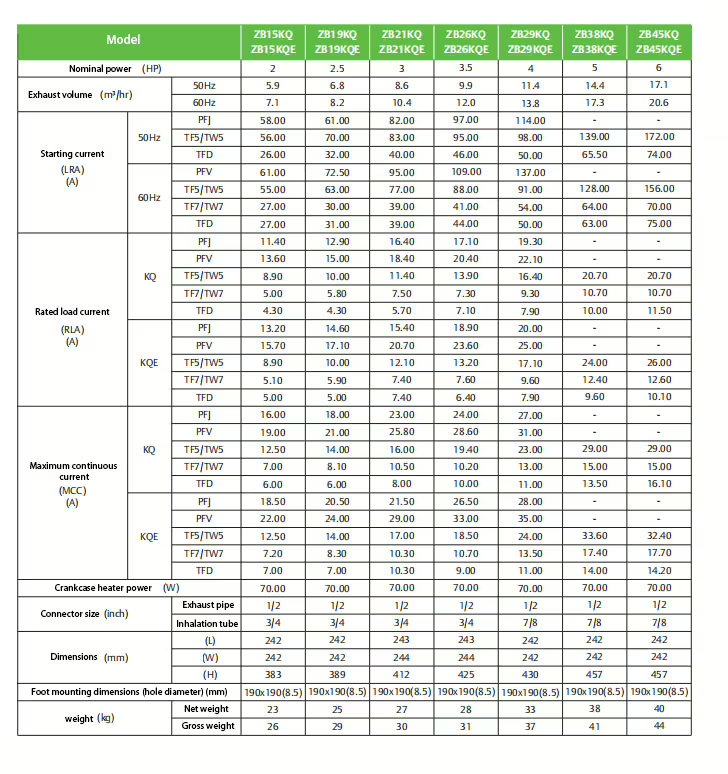
Follow a Rapid Suction Drop Back to Refrigerant Feed
If suction collapses shortly after startup, check liquid-line solenoid operation, filter-drier restriction, sight-glass context, subcooling, expansion-valve feed, distributor, evaporator airflow, and frost. A closed or unstable feed path can pull suction to cut-out and then recover during the off period, repeating compressor short cycling.
The solenoid valve guide and expansion valve guide provide component-specific tests. Do not widen a pressure differential merely to mask a feed fault; that may let the compressor run outside the intended suction condition.
Investigate High-Pressure Stops at the Heat Rejection Side
For a high-pressure event, record condenser inlet conditions, fan or pump command, airflow or water flow, coil cleanliness, valve positions, recirculation, and ambient. A failed fan stage or blocked coil can raise pressure quickly after startup and create compressor short cycling that resembles an electrical trip.
Use the condenser fan selection guide to verify fan behavior. Confirm the trip device and never bypass high-pressure protection. If pressure remains high after airflow or water flow is restored, investigate charge, non-condensables, circuiting, and measurement accuracy.
| First stop signal | System evidence to capture | Common branch |
|---|---|---|
| Temperature controller satisfied | Run time, sensor location, load | Differential, sensor placement, oversized capacity |
| Low-pressure control | Suction trend, feed valves, airflow | Pump-down logic, restriction, starvation |
| High-pressure control | Fans/water, ambient, coil, charge evidence | Heat-rejection failure |
| Motor or phase protection | Voltage, current, terminals, starts | Electrical supply or overload |
| Oil or compressor protection | Oil evidence, delay, pressure, model logic | Lubrication or control fault |
Check Temperature Sensors and Control Differentials
A sensor in a supply-air jet, against a cold wall, near a door, or loosely mounted can drive rapid demand changes. Compare controller temperature with an independent calibrated instrument and inspect filtering, hysteresis, and minimum run or off logic. Compressor short cycling may be a control-location problem even when the refrigeration circuit is healthy.
Review defrost recovery and staged capacity commands. A narrow differential can be especially unstable when capacity is large relative to current load. Change settings only within the approved control strategy and document the original values.
Compare Available Capacity With the Active Load
An oversized single-stage compressor can satisfy a small load before air and product temperatures equalize, then restart soon after. Check design load, current room use, staging, unloading, evaporator fan operation, and thermostat location. Compressor short cycling caused by capacity mismatch needs a system solution, not a wider protection setting.
Use the equipment matching guide to compare compressor, condensing unit, and evaporator performance. Evaluate minimum stable capacity during light load and low ambient, including any product or occupancy changes since design.
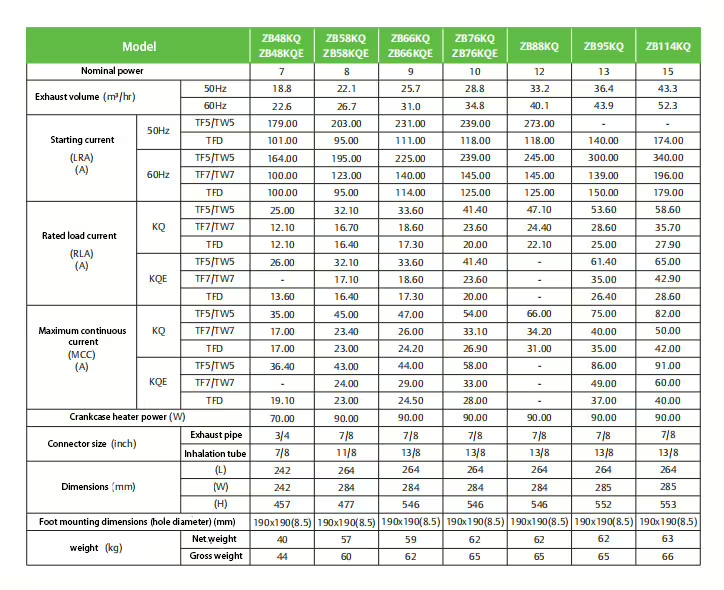
Protect the Compressor While Correcting the Cause
Use approved minimum off time, start limits, and alarm handling so repeated attempts do not continue during diagnosis. These controls reduce stress but can allow room temperature to rise, so operations must understand the temporary condition. Compressor short cycling should never be normalized simply because a delay makes it less frequent.
Apply hazardous-energy procedures using the OSHA standard. Refrigerant handling requires qualified service and applicable EPA guidance. Established refrigeration principles are available in the ASHRAE Handbook.
Verify the Repair Over More Than One Cycle
Repeat the original operating condition and confirm run time, off time, stop reason, pressures, temperatures, current, and room response. Then observe another representative load transition. One long run does not prove compressor short cycling is fixed if the triggering condition has temporarily disappeared. Retain the corrected settings, timestamped trend, and acceptable cycle criteria as the new baseline for future compressor short cycling reports.
Send controller logs, wiring, stop codes, pressure-temperature trends, load information, and equipment models through the contact page. A timestamped compressor short cycling record lets the reviewer follow cause and effect without guessing.

Frequently Asked Questions
What counts as short cycling?
Use the compressor and system limits; compressor short cycling means starts and stops are too frequent or too brief for approved stable operation.
Can a thermostat cause short cycling?
Yes. A narrow differential, poor location, or unstable signal can cause compressor short cycling, but identify the actual stop command first.
Why does low pressure recover when the compressor stops?
Pressures equalize and refrigerant may continue feeding, which can reset the control and repeat compressor short cycling.
Will a longer off delay fix the problem?
It protects starts but does not correct the underlying control, feed, heat-rejection, electrical, or capacity cause of compressor short cycling.
What is the most useful diagnostic record?
A timestamped start-to-stop trend with the first stop signal and system conditions is the strongest compressor short cycling evidence.
